what are the steps to seize evidence from an android device
Mobile device forensics is a branch of digital forensics relating to recovery of digital show or data from a mobile device under forensically sound conditions. The phrase mobile device usually refers to mobile phones; nonetheless, it tin can also relate to any digital device that has both internal memory and communication ability, including PDA devices, GPS devices and tablet computers.
Some of the mobile companies had tried to duplicate the model of the phones which is illegal. So, We see then many new models arriving every year which is the forward step to the farther generations. The Process of cloning the mobile phones/devices in crime was widely recognised for some years, but the forensic study of mobile devices is a relatively new field, dating from the late 1990s and early on 2000s. A proliferation of phones (particularly smartphones) and other digital devices on the consumer market caused a demand for forensic examination of the devices, which could non be met by existing computer forensics techniques.[i]
Mobile devices tin be used to salve several types of personal information such as contacts, photos, calendars and notes, SMS and MMS letters. Smartphones may additionally contain video, email, web browsing information, location information, and social networking letters and contacts.
At that place is growing demand for mobile forensics due to several reasons and some of the prominent reasons are:
- Utilize of mobile phones to shop and transmit personal and corporate information
- Use of mobile phones in online transactions
- Police force enforcement, criminals and mobile phone devices[2]
Mobile device forensics tin can be particularly challenging on a number of levels:[3]
Evidential and technical challenges exist. For example, cell site analysis post-obit from the use of a mobile phone usage coverage, is not an exact science. Consequently, whilst it is possible to determine roughly the cell site zone from which a call was fabricated or received, it is not yet possible to say with whatsoever degree of certainty, that a mobile phone call emanated from a specific location e.g. a residential address.
- To remain competitive, original equipment manufacturers frequently alter mobile phone grade factors, operating organization file structures, information storage, services, peripherals, and even pivot connectors and cables. As a outcome, forensic examiners must use a dissimilar forensic process compared to computer forensics.
- Storage chapters continues to grow cheers to demand for more powerful "mini computer" blazon devices.[4]
- Not simply the types of information only also the way mobile devices are used constantly evolve.
- Hibernation beliefs in which processes are suspended when the device is powered off or idle just at the same time, remaining agile.[2]
As a consequence of these challenges, a broad variety of tools exist to extract evidence from mobile devices; no one tool or method can acquire all the evidence from all devices. Information technology is therefore recommended that forensic examiners, especially those wishing to qualify equally skilful witnesses in courtroom, undergo extensive training in gild to understand how each tool and method acquires evidence; how it maintains standards for forensic soundness; and how it meets legal requirements such as the Daubert standard or Frye standard.
History [edit]
As a field of study, forensic exam of mobile devices dates from the belatedly 1990s and early 2000s. The role of mobile phones in law-breaking had long been recognized by police force enforcement. With the increased availability of such devices on the consumer market and the wider array of communication platforms they support (e.thou. email, web browsing) demand for forensic examination grew.[1]
Early on efforts to examine mobile devices used similar techniques to the commencement computer forensics investigations: analyzing phone contents directly via the screen and photographing important content.[1] All the same, this proved to be a time-consuming procedure, and every bit the number of mobile devices began to increase, investigators chosen for more efficient means of extracting data. Enterprising mobile forensic examiners sometimes used cell phone or PDA synchronization software to "back up" device data to a forensic estimator for imaging, or sometimes, simply performed computer forensics on the hard bulldoze of a suspect computer where data had been synchronized. Nonetheless, this type of software could write to the phone every bit well equally reading it, and could not retrieve deleted data.[5]
Some forensic examiners found that they could call up even deleted data using "flasher" or "twister" boxes, tools developed by OEMs to "wink" a phone's memory for debugging or updating. However, flasher boxes are invasive and can change data; tin can be complicated to employ; and, considering they are not developed as forensic tools, perform neither hash verifications nor (in most cases) inspect trails.[6] For physical forensic examinations, therefore, improve alternatives remain necessary.
To meet these demands, commercial tools appeared which allowed examiners to recover phone memory with minimal disruption and analyze it separately.[ane] Over time these commercial techniques have developed further and the recovery of deleted information from proprietary mobile devices has become possible with some specialist tools. Moreover, commercial tools have even automated much of the extraction process, rendering information technology possible even for minimally trained showtime responders—who currently are much more likely to meet suspects with mobile devices in their possession, compared to computers—to perform bones extractions for triage and data preview purposes.
Professional applications [edit]
Mobile device forensics is all-time known for its awarding to police enforcement investigations, merely information technology is also useful for military intelligence, corporate investigations, private investigations, criminal and civil defense, and electronic discovery.
Types of evidence [edit]
As mobile device engineering advances, the corporeality and types of data that tin be found on a mobile device is constantly increasing. Evidence that can be potentially recovered from a mobile phone may come up from several dissimilar sources, including handset memory, SIM card, and fastened memory cards such every bit SD cards.
Traditionally mobile telephone forensics has been associated with recovering SMS and MMS messaging, besides as call logs, contact lists and phone IMEI/ESN information. However, newer generations of smartphones also include wider varieties of data; from web browsing, Wireless network settings, geolocation data (including geotags independent within prototype metadata), due east-mail and other forms of rich cyberspace media, including important data—such as social networking service posts and contacts—now retained on smartphone 'apps'.[vii]
Internal memory [edit]
Present by and large wink memory consisting of NAND or NOR types are used for mobile devices.[viii]
External retention [edit]
External memory devices are SIM cards, SD cards (usually plant within GPS devices as well every bit mobile phones), MMC cards, CF cards, and the Memory Stick.
Service provider logs [edit]
Although non technically role of mobile device forensics, the call item records (and occasionally, text messages) from wireless carriers often serve equally "back up" evidence obtained afterwards the mobile phone has been seized. These are useful when the phone call history and/or text messages have been deleted from the phone, or when location-based services are not turned on. Call detail records and cell site (tower) dumps can show the phone owner'southward location, and whether they were stationary or moving (i.e., whether the phone's signal bounced off the same side of a single tower, or unlike sides of multiple towers along a detail path of travel).[ix] Carrier data and device data together can exist used to corroborate information from other sources, for instance, video surveillance footage or eyewitness accounts; or to determine the general location where a non-geotagged image or video was taken.
The European Wedlock requires its member countries to retain certain telecommunications information for utilize in investigations. This includes data on calls made and retrieved. The location of a mobile phone can be determined and this geographical data must too exist retained. In the U.s.a., nevertheless, no such requirement exists, and no standards govern how long carriers should retain data or even what they must retain. For example, text messages may exist retained only for a week or two, while phone call logs may be retained anywhere from a few weeks to several months. To reduce the take a chance of bear witness being lost, law enforcement agents must submit a preservation alphabetic character to the carrier, which they so must back up with a search warrant.[ix]
Forensic process [edit]
The forensics process for mobile devices broadly matches other branches of digital forensics; yet, some particular concerns apply. Generally, the process can be broken down into three main categories: seizure, conquering, and examination/assay. Other aspects of the calculator forensic process, such as intake, validation, documentation/reporting, and archiving nonetheless employ.[3]
Seizure [edit]
Seizing mobile devices is covered by the same legal considerations as other digital media. Mobiles will oftentimes be recovered switched on; as the aim of seizure is to preserve testify, the device will oft be transported in the aforementioned state to avoid a shutdown, which would change files.[10] In add-on, the investigator or first responder would adventure user lock activation.
However, leaving the telephone on carries another risk: the device can still make a network/cellular connection. This may bring in new data, overwriting evidence. To prevent a connection, mobile devices will often be transported and examined from within a Faraday cage (or pocketbook). Even and so, there are 2 disadvantages to this method. Get-go, nearly bags render the device unusable, as its touch screen or keypad cannot be used. However, special cages tin be caused that allow the utilize of the device with a run into-through glass and special gloves. The advantage with this option is the ability to too connect to other forensic equipment while blocking the network connection, as well as charging the device. If this option is not available, network isolation is advisable either through placing the device in Plane Mode, or cloning its SIM menu (a technique which can also be useful when the device is missing its SIM carte du jour entirely).[3]
Information technology is to note that while this technique can prevent triggering a remote wipe (or tampering) of the device, it doesn't practise anything against a local Expressionless homo's switch.
Conquering [edit]

iPhone in an RF shield purse
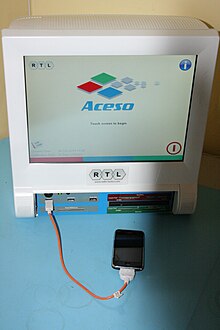
RTL Aceso, a mobile device acquisition unit of measurement
The second step in the forensic process is acquisition, in this example normally referring to retrieval of material from a device (as compared to the bit-copy imaging used in computer forensics).[ten]
Due to the proprietary nature of mobiles it is frequently not possible to acquire data with it powered downwards; most mobile device acquisition is performed live. With more advanced smartphones using advanced memory management, connecting information technology to a recharger and putting it into a faraday cage may non be proficient practice. The mobile device would recognize the network disconnection and therefore it would change its condition information that can trigger the retention managing director to write data.[11]
Most acquisition tools for mobile devices are commercial in nature and consist of a hardware and software component, oftentimes automated.
Examination and analysis [edit]
As an increasing number of mobile devices use high-level file systems, similar to the file systems of computers, methods and tools can be taken over from difficult disk forensics or only demand slight changes.[12]
The FAT file system is generally used on NAND retention.[13] A departure is the block size used, which is larger than 512 bytes for difficult disks and depends on the used retentiveness type, e.m., NOR type 64, 128, 256 and NAND memory 16, 128, 256, or 512 kilobyte.
Unlike software tools tin can extract the data from the memory image. One could apply specialized and automated forensic software products or generic file viewers such as any hex editor to search for characteristics of file headers. The advantage of the hex editor is the deeper insight into the memory direction, but working with a hex editor ways a lot of handwork and file system also as file header knowledge. In contrast, specialized forensic software simplifies the search and extracts the data merely may not observe everything. AccessData, Sleuthkit, ESI Analyst and EnCase, to mention only some, are forensic software products to clarify memory images.[14] Since there is no tool that extracts all possible information, it is advisable to use 2 or more tools for examination. There is currently (Feb 2010) no software solution to get all evidences from flash memories.[viii]
Data conquering types [edit]
Mobile device data extraction tin can be classified co-ordinate to a continuum, along which methods get more technical and "forensically sound," tools become more expensive, analysis takes longer, examiners demand more grooming, and some methods can even go more invasive.[15]
Transmission acquisition [edit]
The examiner utilizes the user interface to investigate the content of the phone's memory. Therefore, the device is used equally normal, with the examiner taking pictures of each screen'south contents. This method has an advantage in that the operating organization makes information technology unnecessary to use specialized tools or equipment to transform raw data into man interpretable information. In practise this method is applied to prison cell phones, PDAs and navigation systems.[xvi] Disadvantages are that only information visible to the operating system can be recovered; that all information is only available in the form of pictures; and the process itself is time-consuming.
Logical conquering [edit]
Logical acquisition implies a bit-past-chip copy of logical storage objects (e.g., directories and files) that reside on a logical storage (e.grand., a file system partition). Logical acquisition has the advantage that system information structures are easier for a tool to extract and organize. Logical extraction acquires information from the device using the original equipment manufacturer awarding programming interface for synchronizing the phone'south contents with a personal computer. A logical extraction is generally easier to piece of work with every bit it does not produce a big binary hulk. However, a skilled forensic examiner volition be able to extract far more information from a physical extraction.
File arrangement acquisition [edit]
Logical extraction usually does not produce whatsoever deleted information, due to it normally being removed from the phone's file organization. However, in some cases—specially with platforms built on SQLite, such as iOS and Android—the telephone may proceed a database file of data which does not overwrite the information only simply marks it equally deleted and available for subsequently overwriting. In such cases, if the device allows file system access through its synchronization interface, information technology is possible to recover deleted information. File system extraction is useful for understanding the file structure, spider web browsing history, or app usage, every bit well as providing the examiner with the power to perform an analysis with traditional computer forensic tools.[17]
Physical acquisition [edit]
Physical acquisition implies a scrap-for-fleck re-create of an entire concrete shop (e.g. flash memory); therefore, it is the method nigh similar to the examination of a personal calculator. A physical conquering has the reward of allowing deleted files and data remnants to be examined. Concrete extraction acquires information from the device by direct admission to the flash memories.
Generally this is harder to achieve because the device original equipment manufacturer needs to secure against arbitrary reading of memory; therefore, a device may be locked to a certain operator. To become around this security, mobile forensics tool vendors often develop their own boot loaders, enabling the forensic tool to access the memory (and often, also to featherbed user passcodes or pattern locks).[eighteen]
More often than not the physical extraction is divide into two steps, the dumping phase and the decoding phase.
Brute force acquisition [edit]
Brute forcefulness acquisition tin can exist performed past 3rd party passcode brute forcefulness tools that transport a series of passcodes / passwords to the mobile device.[19] This is a time-consuming method, merely effective withal.[20] This technique uses trial and mistake in an attempt to create the right combination of password or PIN to authenticate access to the mobile device. Despite the process taking an extensive amount of time, information technology is notwithstanding 1 of the best methods to employ if the forensic professional is unable to obtain the passcode. With current bachelor software and hardware it has become quite easy to intermission the encryption on a mobile device's password file to obtain the passcode.[21] Two manufacturers have become public since the release of the iPhone5,[22] Cellebrite and GrayShift. These manufacturers are intended for law enforcement agencies and police departments. The Cellebrite UFED Ultimate[23] unit costs over $40,000 Us dollars and Grayshifts system costs $15,000.[24] Brute forcing tools are connected to the device and will physically ship codes on iOS devices starting from 0000 to 9999 in sequence until the correct code is successfully entered. One time the code entry has been successful, full access to the device is given and data extraction can commence.
Tools [edit]
Early investigations consisted of alive manual analysis of mobile devices; with examiners photographing or writing downward useful material for utilize as evidence. Without forensic photography equipment such as Fernico ZRT, EDEC Eclipse, or Project-a-Phone, this had the disadvantage of risking the modification of the device content, besides as leaving many parts of the proprietary operating organization inaccessible.
In recent years a number of hardware/software tools have emerged to recover logical and physical testify from mobile devices. Most tools consist of both hardware and software portions. The hardware includes a number of cables to connect the mobile device to the acquisition auto; the software exists to extract the testify and, occasionally, even to clarify it.
Well-nigh recently, mobile device forensic tools have been developed for the field. This is in response both to military units' demand for fast and accurate anti-terrorism intelligence, and to law enforcement demand for forensic previewing capabilities at a crime scene, search warrant execution, or exigent circumstances. Such mobile forensic tools are often ruggedized for harsh environments (e.thousand. the battlefield) and crude treatment (e.g. being dropped or submerged in water).[25]
Generally, because it is impossible for whatsoever 1 tool to capture all prove from all mobile devices, mobile forensic professionals recommend that examiners found entire toolkits consisting of a mix of commercial, open up source, wide support, and narrow back up forensic tools, together with accessories such as battery chargers, Faraday bags or other betoken disruption equipment, and then along.[26]
Commercial forensic tools [edit]
Some current tools include Belkasoft Evidence Center, Cellebrite UFED, Oxygen Forensic Detective, Elcomsoft Mobile Forensic Bundle, Susteen Secure View, MOBILEdit Forensic Express, and Micro Systemation XRY.
Some tools have additionally been developed to address increasing criminal usage of phones manufactured with Chinese chipsets, which include MediaTek (MTK), Spreadtrum and MStar. Such tools include Cellebrite's CHINEX, and XRY PinPoint.
Open source [edit]
Most open source mobile forensics tools are platform-specific and geared toward smartphone analysis. Though not originally designed to be a forensics tool, BitPim has been widely used on CDMA phones as well as LG VX4400/VX6000 and many Sanyo Sprint jail cell phones.[27]
Concrete tools [edit]
Forensic desoldering [edit]
Ordinarily referred to as a "Scrap-Off" technique inside the industry, the concluding and most intrusive method to get a retention image is to desolder the non-volatile retentiveness chip and connect it to a memory chip reader. This method contains the potential danger of total data devastation: information technology is possible to destroy the chip and its content because of the oestrus required during desoldering. Before the invention of the BGA applied science it was possible to attach probes to the pins of the memory scrap and to recover the memory through these probes. The BGA technique bonds the fries directly onto the PCB through molten solder balls, such that it is no longer possible to attach probes.
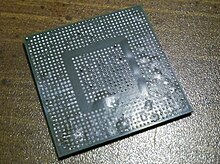
Here you tin encounter that wet in the excursion board turned to steam when it was subjected to intense heat. This produces the and so-called "popcorn result."
Desoldering the fries is done carefully and slowly, so that the heat does not destroy the fleck or data. Earlier the chip is desoldered the PCB is baked in an oven to eliminate remaining water. This prevents the then-called popcorn event, at which the remaining water would blow the chip package at desoldering.
At that place are mainly three methods to cook the solder: hot air, infrared low-cal, and steam-phasing. The infrared low-cal technology works with a focused infrared low-cal axle onto a specific integrated excursion and is used for small chips. The hot air and steam methods cannot focus equally much equally the infrared technique.
Chip re-balling [edit]
After desoldering the chip a re-balling process cleans the bit and adds new tin can balls to the fleck. Re-balling tin can be done in ii different ways.
- The first is to employ a stencil. The stencil is chip-dependent and must fit exactly. And then the tin-solder is put on the stencil. Later cooling the tin the stencil is removed and if necessary a 2nd cleaning stride is done.
- The second method is light amplification by stimulated emission of radiation re-balling.[28] [29] Here the stencil is programmed into the re-balling unit of measurement. A bondhead (looks like a tube/needle) is automatically loaded with one can brawl from a solder ball singulation tank. The ball is then heated by a light amplification by stimulated emission of radiation, such that the tin-solder ball becomes fluid and flows onto the cleaned chip. Instantly later melting the ball the light amplification by stimulated emission of radiation turns off and a new ball falls into the bondhead. While reloading the bondhead of the re-balling unit of measurement changes the position to the next pivot.
A 3rd method makes the entire re-balling process unnecessary. The chip is connected to an adapter with Y-shaped springs or spring-loaded pogo pins. The Y-shaped springs demand to have a brawl onto the pin to constitute an electrical connection, but the pogo pins can be used directly on the pads on the fleck without the assurance.[eleven] [12]
The advantage of forensic desoldering is that the device does not need to be functional and that a copy without any changes to the original data tin exist made. The disadvantage is that the re-balling devices are expensive, so this process is very costly and there are some risks of total data loss. Hence, forensic desoldering should only exist done by experienced laboratories.[13]
JTAG [edit]
Existing standardized interfaces for reading data are built into several mobile devices, e.g., to become position data from GPS equipment (NMEA) or to get deceleration information from airbag units.[sixteen]
Non all mobile devices provide such a standardized interface nor does at that place be a standard interface for all mobile devices, but all manufacturers have i problem in mutual. The miniaturizing of device parts opens the question how to automatically test the functionality and quality of the soldered integrated components. For this problem an industry grouping, the Articulation Exam Action Group (JTAG), developed a test technology called boundary scan.
Despite the standardization there are 4 tasks before the JTAG device interface can be used to recover the memory. To find the right $.25 in the boundary scan register i must know which processor and memory circuits are used and how they are connected to the organization motorbus. When not accessible from exterior ane must detect the test points for the JTAG interface on the printed circuit board and make up one's mind which test signal is used for which betoken. The JTAG port is non always soldered with connectors, such that it is sometimes necessary to open the device and re-solder the access port.[12] The protocol for reading the memory must exist known and finally the correct voltage must exist adamant to prevent harm to the circuit.[11]
The boundary scan produces a complete forensic image of the volatile and non-volatile memory. The take a chance of data change is minimized and the retentiveness chip doesn't accept to be desoldered. Generating the image can be slow and not all mobile devices are JTAG enabled. Also, information technology can exist difficult to detect the test access port.[thirteen]
Control line tools [edit]
System commands [edit]
Mobile devices practice not provide the possibility to run or boot from a CD, connecting to a network share or some other device with clean tools. Therefore, system commands could exist the only style to save the volatile retention of a mobile device. With the risk of modified system commands it must be estimated if the volatile retention is actually of import. A like problem arises when no network connection is available and no secondary retentiveness tin be connected to a mobile device because the volatile memory image must be saved on the internal non-volatile memory, where the user data is stored and most likely deleted important data volition exist lost. System commands are the cheapest method, but imply some risks of information loss. Every command usage with options and output must be documented.
AT commands [edit]
AT commands are old modem commands, e.grand., Hayes control set and Motorola telephone AT commands, and can therefore just be used on a device that has modem support. Using these commands one can only obtain information through the operating arrangement, such that no deleted data can be extracted.[eleven]
dd [edit]
For external memory and the USB flash bulldoze, advisable software, e.g., the Unix command dd, is needed to make the bit-level copy. Furthermore, USB flash drives with memory protection do non need special hardware and tin be connected to any computer. Many USB drives and memory cards accept a write-lock switch that tin can be used to preclude information changes, while making a copy.
If the USB drive has no protection switch, a blocker tin can exist used to mount the bulldoze in a read-only mode or, in an infrequent case, the memory scrap can be desoldered. The SIM and memory cards need a card reader to make the copy.[30] The SIM menu is soundly analyzed, such that it is possible to recover (deleted) data like contacts or text messages.[xi]
The Android operating organization includes the dd control. In a blog mail on Android forensic techniques, a method to live image an Android device using the dd control is demonstrated.[31]
Non-forensic commercial tools [edit]
Flasher tools [edit]
A flasher tool is programming hardware and/or software that can be used to program (flash) the device retentivity, east.one thousand., EEPROM or flash retentiveness. These tools mainly originate from the manufacturer or service centers for debugging, repair, or upgrade services. They tin can overwrite the non-volatile memory and some, depending on the manufacturer or device, can as well read the memory to make a re-create, originally intended as a fill-in. The memory tin can exist protected from reading, east.g., past software command or devastation of fuses in the read circuit.[32]
Note, this would not prevent writing or using the memory internally by the CPU. The flasher tools are easy to connect and apply, but some tin can change the data and have other dangerous options or practice not brand a complete copy.[12]
Controversies [edit]
In general at that place exists no standard for what constitutes a supported device in a specific product. This has led to the state of affairs where unlike vendors ascertain a supported device differently. A situation such as this makes it much harder to compare products based on vendor provided lists of supported devices. For instance a device where logical extraction using 1 production only produces a list of calls made by the device may be listed every bit supported by that vendor while another vendor tin produce much more than data.
Furthermore, different products extract different amounts of information from different devices. This leads to a very complex landscape when trying to overview the products. In full general this leads to a situation where testing a product extensively before buy is strongly recommended. It is quite mutual to utilize at least two products which complement each other.
Mobile phone engineering is evolving at a rapid step. Digital forensics relating to mobile devices seems to be at a stand up however or evolving slowly. For mobile telephone forensics to catch upwards with release cycles of mobile phones, more comprehensive and in depth framework for evaluating mobile forensic toolkits should be adult and data on advisable tools and techniques for each type of phone should exist made bachelor a timely manner.[33]
Anti-forensics [edit]
Anti-computer forensics is more hard because of the small size of the devices and the user's restricted data accessibility.[13] However, at that place are developments to secure the memory in hardware with security circuits in the CPU and retentiveness fleck, such that the retentiveness flake cannot be read even later desoldering.[34] [35]
Meet also [edit]
- List of digital forensics tools
-
 Telephones portal
References [edit]
- ^ a b c d Casey, Eoghan (2004). Digital Testify and Computer Offense, Second Edition. Elsevier. ISBN978-0-12-163104-8.
- ^ a b Ahmed, Rizwan (2009). "Mobile Forensics: An Introduction from Indian Police force Enforcement Perspective". Information Systems, Engineering science and Management. Communications in Computer and Information Science. Vol. 31. pp. 173–184. doi:x.1007/978-iii-642-00405-6_21. ISBN978-three-642-00404-ix.
- ^ a b c Murphy, Cynthia. "Cellular Phone Evidence Data Extraction and Documentation" (PDF) . Retrieved 4 Baronial 2013.
- ^ Tsukayama, Hayley (13 July 2012). "Two-thirds of mobile buyers have smartphones". Washington Postal service . Retrieved 20 July 2012.
- ^ Jansen; et al. "Overcoming Impediments to Prison cell Phone Forensics" (PDF) . Retrieved xx July 2012. [ permanent dead link ]
- ^ Thackray, John. "Flasher Boxes: Back to Nuts in Mobile Phone Forensics". Archived from the original on xv November 2012. Retrieved twenty July 2012.
- ^ Ahmed, Rizwan. "Digital evidence extraction and documentation from mobile devices" (PDF) . Retrieved two Feb 2015.
- ^ a b Salvatore Fiorillo. Theory and practice of wink memory mobile forensics. Theosecurity.com, December 2009.
- ^ a b Miller, Christa. "The Other Side of Mobile Forensics". Officer.com. Retrieved 24 July 2012.
- ^ a b Wayne, Jansen., & Ayers, Rick. (May 2007). Guidelines on prison cell phone forensics. retrieved from http://www.mislan.com/SSDDFJ/papers/SSDDFJ_V1_1_Breeuwsma_et_al.pdf
- ^ a b c d east Willassen, Svein Y. (2006). "Forensic analysis of mobile telephone internal retention". IFIP Int. Conf. Digital Forensics. CiteSeerXten.one.1.101.6742.
- ^ a b c d Marcel Breeuwsma, Martien de Jongh, Coert Klaver, Ronald van der Knijff, and Mark Roeloffs. (2007). retrieved from Forensic Information Recovery from Flash Retention Archived 2016-10-23 at the Wayback Motorcar. Small l Scale Digital Device Forensics Journal, Volume 1 (Number 1). Also, many of these tools have become more than skilful at recovering user passcodes/passwords, without user data loss. An example of a tool commonly used for this area is a BST Dongle .
- ^ a b c d Ronald van der Knijff. (2007). retrieved from x Good Reasons Why You Should Shift Focus to Pocket-sized Scale Digital Device Forensics Archived 2008-10-fifteen at the Wayback Motorcar.
- ^ Rick Ayers, Wayne Jansen, Nicolas Cilleros, and Ronan Daniellou. (October 2005). Retrieved from Cell Phone Forensic Tools: An Overview and Assay. National Institute of Standards and Technology.
- ^ Brothers, Sam. "iPhone Tool Nomenclature" (PDF). Archived from the original (PDF) on 20 October 2012. Retrieved 21 July 2012.
- ^ a b Eoghan Casey. Handbook of computer criminal offense investigation – forensic tools and engineering. Academic Printing, 2. edition, 2003.
- ^ Henry, Paul. "Quick Look – Cellebrite UFED Using Extract Phone Data & File Organisation Dump". Retrieved 21 July 2012.
- ^ Vance, Christopher. "Android Physical Acquisitions using Cellebrite UFED". Archived from the original on 12 August 2011. Retrieved 21 July 2012.
- ^ Satish., Bommisetty (2014). Practical mobile forensics : dive into mobile forensics on iOS, Android, Windows, and BlackBerry devices with this action-packed, practical guide. Tamma, Rohit., Mahalik, Heather. Birmingham, United kingdom of great britain and northern ireland: Packt Pub. ISBN9781783288328. OCLC 888036062.
- ^ "Brute-force set on". Springer Reference . SpringerReference. Springer-Verlag. 2011. doi:10.1007/springerreference_9302.
- ^ Whittaker, Zack. "For $15,000, GrayKey promises to crack iPhone passcodes for law". ZDNet . Retrieved 2018-07-02 .
- ^ Whittaker, Zack. "Leaked files reveal scope of Israeli firm'south phone slap-up tech". ZDNet . Retrieved 2018-07-02 .
- ^ "UFED Ultimate". Cellebrite.com.
- ^ Fob-Brewster, Thomas. "Mysterious $15,000 'GrayKey' Promises To Unlock iPhone Ten For The Feds". Forbes . Retrieved 2018-07-02 .
- ^ "Mobile Digital Forensics for the Military". Dell Inc. Retrieved 21 July 2012. [ dead YouTube link ]
- ^ Daniels, Keith. "Creating a Cellular Device Investigation Toolkit: Basic Hardware and Software Specifications". SEARCH Group Inc.
- ^ "The Electronic Evidence Data Center". Retrieved 25 July 2012.
- ^ Homepage of Factronix
- ^ Video: Re-balling process
- ^ "USB Blocker | Endpoint Protector". www.endpointprotector.com . Retrieved 2021-03-20 .
- ^ Lohrum, Mark (2014-08-x). "Live Imaging an Android Device". Retrieved three April 2015.
- ^ Tom Salt and Rodney Drake. United states of america Patent 5469557. (1995). Retrieved from Code protection in microcontroller with EEPROM fuses. Archived 2011-06-12 at the Wayback Machine
- ^ Ahmed, Rizwan. "Mobile Forensics: an Overview, Tools, Futurity trends and Challenges from Constabulary Enforcement perspective" (PDF) . Retrieved 2 February 2015.
- ^ Secure Boot Patent
- ^ Harini Sundaresan. (July 2003). Retrieved from OMAP platform security features, Texas Instruments.
External links [edit]
- Conference 'Mobile Forensics Earth'
- Bit-Off Forensics (forensicwiki.org)
- JTAG Forensics (forensicwiki.org)
- Mobile Phone Forensics Example Studies (QCC Global Ltd)
Source: https://en.wikipedia.org/wiki/Mobile_device_forensics
0 Response to "what are the steps to seize evidence from an android device"
Post a Comment